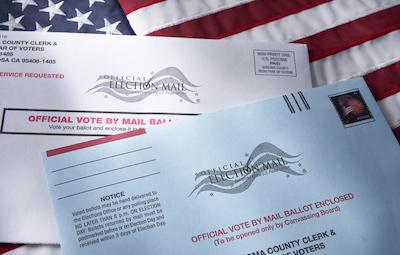
I have successfully voted by mail as an absentee voter for over 40 years, which is essentially my entire adult life. This experience, combined with my travel to over 40 countries, has made me realize that absentee voting is an integral part of our American voting experience.
My home state of Washington was an early adopter of absentee voting, or ”vote by mail” as it is more commonly called today. When I entered active duty in the Air Force in 1984, all you had to do was request absentee status from your local election official and the absentee ballot was mailed to your home, or in my case to my active duty station in Ohio.
In December 2004, Washington State had the closest Gubernatorial race in history decided when Christine Gregoire became Governor by 133 votes after two recounts. Suffice it to say, we’ve had plenty of practice managing a secure and effective absentee voting process in Washington state. It works.
In 2011, Washington state mandated “vote by mail” in all elections. This law was a lagging indicator because 38 of the 39 counties in WA had already mandated absentee voting. It gave the Evergreen State what it really wanted – safe, effective voting with an electorate that made time to vote thoughtfully. Multiple non-partisan research studies have proven the efficacy of vote by mail.
The History of Voting and Elections in Washington State - Vote-By-Mail Fact Sheet
In 1986, while I was a young Air Force officer, a bi-partisan congress passed the Uniformed and Overseas Citizen Absentee Voting Act or UOCAVA. This federal law provides unique benefits to this group of voters and it is arguably one of the most important pieces of bi-partisan legislation related to voting in the United States. UOCAVA provides several important benefits to those voters that a normal absentee voter does not get:
- Acceptance of the Federal Post Card Application (FPCA) - or what we at Overseas Vote call the Registration/Ballot Request form as it allows you to register to vote and request your absentee ballot at the same time.
- Electronic ballot delivery from your Election Office to you, wherever you are in the world - requested with a simple checkmark on the FPCA.
- 45-day minimum ballot delivery prior to Election Day compared to the normal absentee voter which is typically 20-30 days prior to the election.
- If something goes wrong in getting your ballot, you have a backup plan and it’s called the Federal Write-In Absentee Ballot (FWAB).
- (And some states allow electronic ballot return – which makes folks like me very happy!)
A Family History of Service Underscores the Personal Experience of Voting
I am motivated to vote not only because of my military experience, but also because of my family’s history of service to others. Our country is a land of immigrants and my family tree is similar to that of many Americans. My great grandpa Syvert immigrated from Norway in 1882 at the age of 21. Like many Norwegians at that time, Syvert came looking for an opportunity to build a family and community in the farm lands of Minnesota and North Dakota. Syvert’s son - my Grandpa Lewis - was born in Minnesota and served in France during WW I. Grandpa Lewis had two sons who both served. Uncle Al was an Army radio operator in WW II. Uncle Merlin was a Merchant Marine in WW II and he died in service to his country at the age of 21.
My dad served in the Navy in WW II. My brother served in the Air Force after Vietnam. And then I served in the Air Force during the Cold War when the Berlin Wall fell. More recently, my son-in-law served in the Navy and deployed multiple times on the USS Carl Vinson. These were ordinary people doing extraordinary things. They served honorably and I honor their service by voting in every election.
For the last 5 years, my wife and I have resided in Spain which means that we’ve had to re-educate ourselves on the registration and ballot submission process according to the official federal rules of overseas and military voting.
Behind Abroad Has Brought Me Closer
One surprising thing has happened along the way – we feel more committed and obligated to the American republic than ever before. Our voting experience from overseas has been positive thanks to our home state of Washington and the online services it provides to overseas and military voters. Here are the practical steps we use each election cycle:
- Fill out the Federal Post Card Application (FPCA) every year by using a trusted source for overseas and military voting. Check out the Voter Services and Tools listed on the Overeas Vote website.
- I create a voting plan with the Voter Journey Map - How to Vote in America on US.VOTE
- When an election occurs, I receive an email notification with instructions on how to access my ballot from my state.
- I research the candidates / initiatives on the ballot by using my local election officials’ website or this Sample Ballot Lookup Tool | U.S. Vote Foundation.
- I vote, print and sign an affidavit. Then I receive an email confirmation that my signature was verified.
- I receive a link to track my ballot as it is being “processed” and “counted”.
Don't Vote by Omission
But here is the thing about elections - they are typically decided not only by those who cast votes but also by those who don’t. Fully 25 percent of the ballots in 2020 were cast by people who didn’t vote in 2016. If I don’t vote and stay quiet, then I become part of the machine through my silence. I am speaking out now because silence is complicity and comfort is not an excuse. If you feel powerless, I implore you to realize that you’re not. If you stay silent and don’t vote for whatever reason, somebody else wins. Please take action and exercise your right to vote in 2026.
Register to Vote and Request Your Overseas or Military Ballot Now!
Check out the All States' Upcoming Primaries Chart
Discover More about the Midterms: When are the Midterms and What is their Purpose?
Authored By Bill Shadle, Jan. 2026