Blog

suitcase wrapped in american flag with icons like statue of liberty and empire state building bulging out of it
Yes, if you are a U.S. citizen abroad you are eligible to vote in the 2026 midterm elections. During the midterm elections all 435 seats in the U.S. House of Representatives and one-third of the seats (100) in the U.S. Senate are up for vote.

Whether you live overseas long-term, or are there temporarily studying abroad or on a work assignment, you are entitled to vote.

Be sure to get started as soon as possible to register and request your overseas ballot. The midterm election season starts with primaries in all states and finishes with general election in November.
person in army fatigues pinning on an i-voted badge
We have good news. U.S. Vote Foundation is teaming up with the Secure Families Initiative and their Voting Ambassador Program to ensure that voters are informed, supported, and confident when they vote in U.S. elections. The 2026 election cycle is an opportunity for voters to turn trusted guidance into meaningful participation.

Midterm Elections Matter: military members, their families and overseas citizens are protected by the Uniformed and Overseas Citizens Absentee Voting Act, which gives this group of voters certain voting benefits no matter where in the world they live.
There is a persistent misconception that Americans who live abroad somehow leave America behind. Some may, but most of us do not. We bring America with us. You do not dispose of your citizenship by crossing a border. Your values, your civic identity, your sense of responsibility to your democracy travel with you. We are Americans wherever we go.

For decades, Americans abroad have been welcomed around the world as exactly who we are. We do not assume other identities; we represent our country simply by living our lives. In doing so, we form a quiet, global network of American presence—visible, engaged, and connected. This worldwide community is not a liability to the United States. It is an extraordinary asset.

And it costs the United States nothing.
hand holding US passport in front of view of blurred red-roofed buildings
When I cast my very first absentee ballot in the 1996 elections while stationed in North Carolina, and again in the midterm elections of 1998 from California, these actions reminded me that I was also a stakeholder in our democracy. I wasn’t simply fixing generators for our government—I was voluntarily participating in the selection of the people who ran it.

I have now been a UOCAVA (Uniformed and Overseas Citizens Absentee Voting Act) voter for a combined seventeen years – four as a service member, and thirteen as a civilian veteran residing outside the United States.
Simple icon of documents and words, Guest Blog
Timely ballot request by overseas and military voters, coupled with timely ballot delivery on the part of the local election officials, and extended ballot receipt deadline for ballots postmarked by the deadline is the formula that will assure that voters have time to vote, return their ballots and have them counted.

Overseas and military voters have every right to ask that they be given the opportunity to cast ballots in federal, state, and local elections and that those ballots should be counted, no matter where the service of our country has taken them.
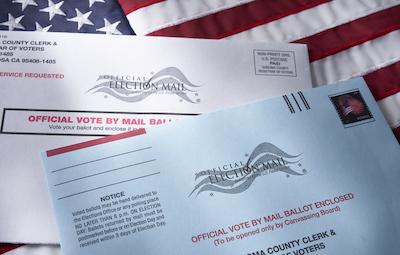
Two vote-by-mail envelopes lying on a US flag backdrop
I have successfully voted by mail as an absentee voter for over 40 years, which is essentially my entire adult life. This experience, combined with my travel to over 40 countries, has made me realize that absentee voting is an integral part of our American voting experience.

I am motivated to vote not only because of my military experience, but also because of my family’s history of service to others.

One surprising thing has happened along the way – we feel more committed and obligated to the American republic than ever before.
globe with check mark and title overseas voting
American citizens living, working, serving, or studying abroad carry their right to vote wherever they may be in the world. U.S. Vote Foundation celebrates and reinforces this right to vote through our Overseas Vote initiative, which has consistently stood at the forefront of safeguarding the voting rights of overseas and military citizens.
In the face of recent efforts to encumber and restrict our right to vote as overseas and military voters covered by the Uniformed and Overseas Citizen Absentee Voting Act (UOCAVA), —the Foundation and its partners have responded with swift and determined statements that encapsulate our collective resolve to defend our voting rights and processes.
sign with north carolina map in grey with voter alert across it
Some North Carolina Overseas and Military Voters' Ballots were challenged by Jefferson Griffin in the race for a seat on the NC Supreme Court race.

Justice Allison Riggs won the race and after two recounts, she won the race by 734 votes. However, Jefferson Griffin embarked on a long court battle claiming the election was not properly conducted and some votes should be tossed out.

See the latest updates and news on this case which is not settled.
american flag flying in wind from boat on ocean
A coalition of nonpartisan voter, overseas and military advocacy organizations, including U.S. Vote Foundation, took action in a critical legal battle for overseas and military voter rights. With the filing of an amicus curiae brief in Pennsylvania, the battle took a decisive turn.

The case poses a threat to Pennsylvania’s military personnel deployed overseas and their families, as well as U.S. citizens living abroad who vote in PA, in the upcoming 2024 election.