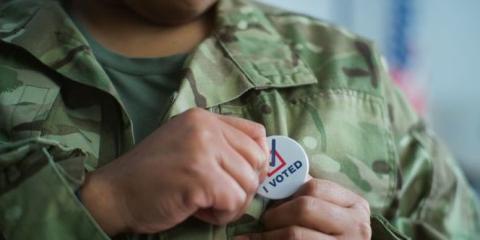
Serving in the military or living overseas should never mean losing your voice in American democracy.
Unfortunately, military voters have an average voter turnout of 25% during midterm elections, which is 20% below their domestic civilian counterparts. For overseas civilian U.S. voters, it’s as low as 3.4%.
Lower turnout is not about lack of interest. It is usually about uncertainty: Can I vote in midterm elections? Am I registered correctly? What are the deadlines in my state? Will my ballot arrive on time? What should I do if something goes wrong?
We have good news. U.S. Vote Foundation and its Overseas Vote initiative are teaming up with the Secure Families Initiative and their Voting Ambassador Program to ensure that voters are informed, supported, and confident when they vote in U.S. elections. The 2026 election cycle is an opportunity for voters to turn trusted guidance into meaningful participation.
Why Midterm Elections Matter
Military members, their families and overseas citizens are protected by the Uniformed and Overseas Citizens Absentee Voting Act (UOCAVA), which gives this group of voters certain voting benefits no matter where in the world they live. For the purposes of this blog, we will call overseas and military voters, “UOCAVA voters”.
An example of benefits provided under UOCAVA is that requested ballots must be sent to UOCAVA voters at least 45 days prior to each federal election compared to 18 days in advance for domestic absentee voters. Another benefit is that UOCAVA voters can request blank ballots be sent to them electronically - a big time-saver! (Hint: printer access is essential, as most states require you to download and print the ballot.)
UOCAVA voters are not symbolic participants in elections. In close races, overseas ballots regularly make a difference—particularly in congressional and statewide contests. A relatively small number of ballots can influence who controls a seat or even which party holds a majority.
Even with low overall turnout, a focused and engaged overseas voting community can make an outsized impact, especially in tight elections.
This is where trusted messengers and clear voter support tools can make a measurable difference.
The Role of Voting Ambassadors: Trusted Guides in the Process
Voting Ambassadors sponsored by the Secure Families Initiative (SFI) serve as trusted, nonpartisan sources of information for military members, their families and overseas voters (including veterans). These volunteers help translate complex election rules into clear, actionable steps, which is especially important because UOCAVA voters interact with election systems across 50 states, each with different timelines and requirements.
A Voting Ambassador from SFI is a military-connected voter who:
- Is trained on the UOCAVA voter registration and ballot request process.
- Is provided access to an online toolkit on how to host voter registration drives in your community.
- Can assist friends and family to register online - no printing required!
- Uses social media to share important election news.
- Becomes part of a network that will support you and your community access to voting.
The military consists of nearly 50% members of color, and 92% of active-duty spouses are women. By all of us working together to improve our diverse community’s access to the polls, we build the power to hold our representatives accountable for improving the safety, dignity, and quality of life for all military families. Voting Ambassadors embrace that powerful legacy - one built by generations of military communities. Their credibility and reach help replace uncertainty with confidence.
Think of this talented group as a “force multiplier” that can simplify and personalize the process for individual UOCAVA voters. If the Voting Ambassador program sounds like it might be a good fit for you, you can sign up here or reach out directly to Maria Campbell – SFI Voting Ambassador Program Organizer – at maria.campbell@securefamiliesinitiative.org.
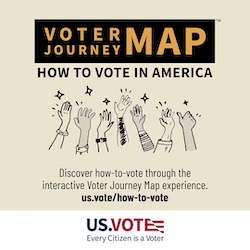
Using the Voter Journey Map: Clarity from Start to Finish
Each voter can personalize their own election experience through the Voter Journey Map created by U.S. Vote Foundation and made available on the new us.vote site. This tool breaks voting down into a simple, visual pathway that shows voters exactly where they are in the process according to their state process and deadlines.
The Voter Journey Map helps UOCAVA voters:
- Understand the full process—from registration to ballot return to their Local Election Office.
- Anticipate key deadlines specific to their state.
- Identify common pain points before they become problems.
- Stay motivated by seeing progress along the journey.
Voting Ambassadors can use the Voter Journey Map to guide conversations, presentations, or one-on-one support, ensuring voters are never left guessing about their next step. Every voter can create a personalized checklist in their Voter Journey Map that they can download and take with them.
The Voter Help Desk: Real Support When It Counts
Even with preparation, questions and issues can arise. The Voter Help Desk at U.S. Vote Foundation is designed to be the safety net for UOCAVA voters who need personalized assistance.
The Voter Help Desk provides:
- Clear answers to state-specific questions.
- Guidance when ballots are delayed or missing.
- Support for technical or procedural challenges.
- Reassurance that help is available right up to Election Day.
Encouraging voters to use the Voter Help Desk early — and without hesitation — can be the difference between an abandoned ballot and a counted vote. Never let an open question stand between you and the ballot box!
Turning Engagement into Impact
UOCAVA voters now have access to trusted Voting Ambassadors who can help voters create their own personalized Voter Journey Map. And if something goes wrong that needs deeper investigation, the Voter Help Desk at U.S. Vote Foundation has their back. These teams and tools work together to transform voting from a confusing obligation into a confident civic act.
Democracy depends on participation. When overseas Americans vote, they reaffirm that citizenship does not end at the border. The historically low turnout numbers are not a verdict — they are an invitation.
In 2026, the message is clear and positive: You are not voting alone—and your vote matters.
Authored By Bill Shadle, February 2026
Bill Shadle is an Air Force veteran (1984-1990) who has over 30 years of executive leadership experience in global operations, supply chain and logistics for technology companies. He volunteers as a Voting Ambassador with the Secure Families Initiative.